Why Lord Rama Placed Rajdharma Above Family Duties: His Promise to Dasharatha and Eternal Love for Sita
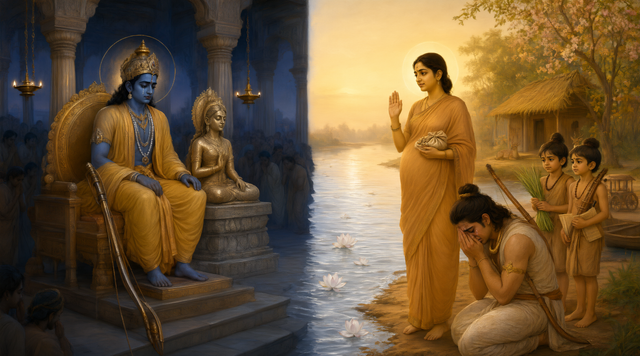
Lord Rama is revered as Maryada Purushottam, the ideal human being who placed dharma above personal desires, royal privileges and even his own happiness. His life in the Ramayana raises a difficult question: why would a man who loved his wife deeply agree to live separately from her after fighting an entire war to bring her back?
The answer, within a traditional interpretation of the Ramayana, lies in Rama's commitment to Rajdharma and the responsibility he accepted towards Ayodhya.
Before departing for fourteen years of exile, Rama assured his father, King Dasharatha, that he would return after fulfilling his obligation. Later, he made clear to Bharata that he would complete the exile and return to the responsibilities awaiting him.
This commitment shaped the course of Rama's life. He surrendered the throne to honour his father's word, returned to Ayodhya to fulfil his royal responsibilities and, in the Uttara Kanda narrative, faced a devastating conflict between his love for Mata Sita and his understanding of a king's duties.
Yet Rama's separation from Sita did not lead him to take another wife. The Ramayana describes him using a golden image of Janaki during his sacred yajnas, preserving her place as his wife.
The complete sequence reveals why Rama's character is associated with sacrifice, personal restraint and a lifelong commitment to dharma.
Rama's Promise to King Dasharatha: Fourteen Years of Exile and a Return to Duty
When Queen Kaikeyi demanded that Bharata receive the throne and Rama spend fourteen years in exile, King Dasharatha found himself trapped by his own promises.
Rama could have refused. He was the chosen successor, loved by his family and respected by the people of Ayodhya. Yet he accepted exile to protect his father's honour.
In Ayodhya Kanda, Sarga 34, Rama reassures Dasharatha that he will return after completing fourteen years in the forest. His words express his commitment to his father and to the obligation he has accepted.
After Dasharatha's death, Bharata approaches Rama and begs him to return to Ayodhya. Rama again refuses to abandon the fourteen-year commitment. He insists that the promise must be completed and that Bharata should administer the kingdom until his return.
This creates a meaningful connection between the two responsibilities.
First, Rama must complete the exile to honour Dasharatha's word. Then he must return to fulfil his responsibilities towards the kingdom rather than permanently withdraw from public life.
It is important to distinguish the recorded promise from its wider interpretation. Rama explicitly commits to returning after exile, and his later conversations establish his responsibility towards Ayodhya. The idea that he accepted a lifelong obligation to the kingdom is a reading of these events together, rather than a separate verbatim promise that he would always place the kingdom above his wife.
For Rama, kingship was not simply a reward awaiting him after fourteen difficult years. It was a responsibility that he ultimately returned to accept.
Why Did Rama Choose Rajdharma Over His Life With Sita?
The Uttara Kanda describes how criticism concerning Mata Sita spread among some citizens of Ayodhya after Rama's coronation.
Sita had already undergone the ordeal associated with Agni Pariksha, and Rama knew of her innocence. Yet the account portrays Rama as deeply troubled by the consequences of public criticism for the reputation of the monarchy.
As king, Rama was responsible not only for his family but for the kingdom he had returned to govern. His understanding of Rajdharma brought him into conflict with his responsibilities as a husband.
He consequently ordered Sita to be left near Valmiki's hermitage.
This decision is among the most painful and debated episodes of the Ramayana. Sita suffered separation and eventually raised Lava and Kusha in the hermitage.
Within the interpretation explored here, Rama's conduct follows a tragic cause-and-effect relationship. He had returned to Ayodhya to fulfil his responsibilities, but fulfilling what he understood as Rajdharma now required a personal sacrifice that his family also had to bear.
It does not mean Sita was guilty, nor does it establish that public suspicion was justified. The episode shows the consequences of Rama's chosen understanding of royal duty, including the suffering imposed upon an innocent person.
Did Lord Rama Continue to Live Like an Ascetic After Sita's Exile?
One important feature of Rama's story is that separation from Sita did not lead him to seek a replacement for her.
Devotional interpretations of his later life emphasise his continued personal austerity, including traditions describing simple food, sleeping on the ground and avoiding royal comforts. These details communicate the idea that Rama did not regard his position as king as a reason to enjoy an unrestricted life of luxury after losing Sita's companionship.
The Valmiki Ramayana explicitly describes Rama sleeping on the ground during his forest exile. A claim that he slept on the floor and ate non-royal food throughout every remaining year after Sita's separation needs a distinct textual source before it can be stated as a verified lifelong practice.
His refusal to remarry, however, is directly attested in the Uttara Kanda.
This distinction strengthens the central interpretation. Rama exercised royal authority, yet the narrative does not portray him replacing Sita with another queen. His public duty continued, but his marital commitment remained attached to her.
The contrast between the king's responsibilities and his personal loss is fundamental to understanding the later stages of his life.
Why Did Rama Refuse to Marry Again?
A king in ancient India could have multiple wives, and Dasharatha himself had several queens. Rama nevertheless remained committed to Sita.
The Uttara Kanda explicitly states that Rama did not choose another wife after their separation.
Valmiki Ramayana, Uttara Kanda 7.99.8
न सीतायाः परां भार्यां वव्रे स रघुनन्दनः।
यज्ञे यज्ञे च पत्न्यर्थं जानकी काञ्चनी भवत्॥
Meaning: The descendant of Raghu chose no wife other than Sita. At every sacrifice, a golden image of Janaki stood in the place of his wife.
This is among the clearest scriptural statements concerning Rama's continuing marital devotion.
The verse establishes two connected facts within the narrative: Rama did not remarry, and he retained Sita's position in his religious ceremonies through a golden representation.
His decision is significant because royal responsibilities and Vedic ceremonies could have provided practical reasons to marry again.
Instead, Rama chose a different path.
Sita remained his wife in the religious and symbolic sense expressed by the text, even when they were physically separated.
The Golden Statue of Sita During the Ashwamedha Yajna
The Ashwamedha Yajna was an important royal Vedic ceremony associated with kingship, sovereignty and ritual responsibility.
The Uttara Kanda describes Rama preparing to undertake this sacrifice. Because a royal sacrificial ceremony involved the participation of the king's wife, Sita's absence created a practical and religious difficulty.
Rama's solution was not to marry another woman. He arranged for a golden representation of Sita to fulfil her ceremonial role.
In Uttara Kanda 7.91.25, Rama instructs Bharata to bring forward his golden wife for the sacrificial proceedings. The later verse, 7.99.8, confirms that a golden Janaki served in the wife's place during his yajnas.
The cause-and-effect relationship is especially important:
- Rama and Sita were physically separated following the decision described in the Uttara Kanda.
- Rama remained committed to Sita and did not marry another woman.
- The royal yajnas still required the appropriate ceremonial participation of a wife.
- A golden image of Sita represented her presence in those sacred rituals.
The image was therefore not merely an ornament. It held a recognised ceremonial role in the narrative.
The king who had accepted separation from Sita as part of his understanding of Rajdharma still refused to remove her from his marital and ritual life.
Does Sita's Golden Image Support the Hindu Tradition of Murti Puja?
The golden image of Sita provides an interesting example of the religious significance of a physical representation.
In Hindu traditions, a murti is not necessarily understood as an ordinary object that replaces the divine. Depending on the tradition and ceremony, an image may serve as a focus of devotion, a consecrated form associated with divine presence or a representation through which a particular religious relationship is expressed.
Rama's golden image of Sita was used in a specific ritual context: it represented his absent wife during sacrificial ceremonies.
This supports a broader principle found in Hindu ritual practice: physical presence and meaningful ceremonial representation are not always treated as identical requirements.
The gold itself was not being described as a replacement for Sita as a person. Rather, her representation fulfilled a role in ceremonies that Rama continued to perform without marrying again.
There is an important historical distinction. Murti Puja encompasses many forms of Hindu image worship and has a development that cannot be traced to this single event. Rama's use of the golden image does not prove that he originated Murti Puja.
It does, though, offer scriptural material for understanding why representations can have religious significance beyond their physical substance.
In Rama's case, the golden Janaki expressed a continuing marital bond within sacred ritual.
Understanding the Cause and Effect of Rama's Decisions
Rama's life can be understood through a connected sequence of obligations, choices and consequences.
| Event | Rama's decision | Consequence |
|---|---|---|
| Dasharatha's promise to Kaikeyi | Accepts fourteen years of exile | Protects his father's word |
| Bharata requests his return | Refuses to abandon the agreed period | Preserves the commitment and leaves Ayodhya under Bharata's administration |
| Completion of exile | Returns to Ayodhya | Assumes the responsibilities of kingship |
| Public criticism concerning Sita | Chooses separation in the Uttara Kanda narrative | Creates profound suffering for Sita and Rama |
| Life after separation | Does not marry another woman | Preserves his marital commitment to Sita |
| Performance of sacred yajnas | Uses a golden representation of Janaki | Maintains Sita's ceremonial position as his wife |
These events help explain Rama's character through the relationship between duty and sacrifice.
The promise to Dasharatha establishes the seriousness with which Rama accepts obligations. His return to Ayodhya leads to the responsibilities of kingship. The separation from Sita illustrates how those responsibilities could conflict with family life. His refusal to remarry demonstrates that separation did not end his commitment to her.
The narrative does not require us to describe every consequence as desirable. Indeed, the emotional weight of the story comes from the suffering associated with Rama's decisions.
Rama as Maryada Purushottam: The King Who Would Not Replace His Wife
The title Maryada Purushottam reflects the traditional view of Rama as an exemplary figure who respects moral responsibilities and the boundaries of righteous conduct.
His life offers a distinctive understanding of leadership. Rama does not treat the throne as permission to abandon promises or personal commitments whenever they become inconvenient.
He accepts fourteen years of exile to fulfil Dasharatha's word. He returns to Ayodhya rather than rejecting his public duties. After his separation from Sita, he does not establish a new marriage to make his ceremonial and royal life easier.
The golden image of Sita becomes one of the most revealing details in this narrative. The king continues performing the duties expected of him, yet Sita retains the place of his wife.
That combination of royal responsibility and enduring marital commitment is central to this interpretation of Rama's life.
It presents him not as a ruler without personal feelings, but as one whose decisions carried immense emotional consequences.
Summary: Rama's Promise, Rajdharma and His Lifelong Commitment to Sita
Rama's decision to fulfil his father's word established a pattern that continued throughout his life. He accepted commitments even when fulfilling them meant giving up something precious.
His return after fourteen years led him to the throne of Ayodhya and the responsibilities of Rajdharma. In the Uttara Kanda narrative, those responsibilities became entangled with the painful separation from Mata Sita.
Yet Rama never married another woman. The golden representation of Sita used during his yajnas demonstrates how her place in his life remained religiously significant even after their physical separation.
The episode offers an important connection between Rajdharma, marital fidelity, sacrifice and the role of sacred representation in Hindu traditions.
Rama's story is therefore not simply about choosing a kingdom over his wife. It is about the tension between responsibilities he believed he must fulfil and a marital commitment he did not abandon.
Frequently Asked Questions
1. Did Lord Rama promise Dasharatha that he would return after fourteen years?
Yes. The Ayodhya Kanda records Rama assuring Dasharatha that he would return after completing fourteen years in exile. His later discussions with Bharata establish his commitment to completing the exile and returning to his responsibilities.
2. Was Sita's exile connected to Rama's Rajdharma?
In the Uttara Kanda narrative, Rama's decision concerning Sita is associated with public criticism and his understanding of the responsibilities of kingship. This creates a connection between his return to rule Ayodhya and the difficult decisions he subsequently made.
3. Did Lord Rama sleep on the floor and eat simple food after Sita left Ayodhya?
Such austerities appear in devotional interpretations of Rama's later life. The Ramayana clearly describes his austere living during forest exile, but the claim that these exact practices continued every day for the remainder of his reign requires additional textual verification.
4. Why did Rama never marry another woman?
The Uttara Kanda states that Rama chose no wife other than Sita. His golden representation of Janaki was used during sacred ceremonies in place of an accompanying wife.
5. Why did Rama use a golden statue of Sita during the Ashwamedha Yajna?
The image fulfilled Sita's ceremonial role during the sacrificial proceedings. Rama could therefore continue his religious obligations without taking another wife.
6. Does Rama's golden statue of Sita prove Murti Puja began with him?
No. The episode demonstrates a religious use of physical representation, but it does not establish the historical origin of Murti Puja. It can be understood as a scriptural parallel to the significance of sacred images in Hindu practice.
7. What does Rama's life teach about Rajdharma and family responsibilities?
Rama's story illustrates the difficulty of balancing public responsibility, fidelity to promises and family relationships. His exile, return to kingship, separation from Sita and refusal to remarry show how deeply these obligations shaped his life.
References
Primary scriptural sources
- Valmiki Ramayana, Ayodhya Kanda, Sarga 34, Rama's assurance to Dasharatha that he will return after fourteen years.
https://www.wisdomlib.org/hinduism/book/the-ramayana-of-valmiki/d/doc423981.html
- Valmiki Ramayana, Ayodhya Kanda, Sarga 107, Rama's discussion with Bharata concerning Dasharatha's promises and the governance of Ayodhya.
https://www.valmikiramayan.net/ayodhya/sarga107/ayodhyaroman107.htm
- Valmiki Ramayana, Ayodhya Kanda, Sarga 88, descriptions of Rama's austerities during exile.
https://www.valmikiramayan.net/ayodhya/sarga88/ayodhyaroman88.htm
- Valmiki Ramayana, Uttara Kanda, Sargas 43–45, the public criticism concerning Sita and Rama's decision.
https://vedanta.study/research/ramayana/uttara.html
- Valmiki Ramayana, Uttara Kanda 7.91.25, the golden representation of Sita during the Ashwamedha preparations.
https://eternalraga.com/en/scriptures/ramayana/uttara-kanda/91
- Valmiki Ramayana, Uttara Kanda 7.99.8, Rama's refusal to remarry and the golden image of Janaki used during yajnas.
https://www.sacredreads.com/books/ramayana-uttara/chapters/99
Additional textual scholarship
- Oral–Written–Performed: The Rāmāyaṇa Narratives in Indian Literature and Arts, discussing Ramayana traditions, the golden Sita and textual interpretations.
https://tile.loc.gov/storage-services/master/gdc/gdcebookspublic/20/22/38/95/59/2022389559/2022389559.pdf
Opinions (0)
No opinions yet. Be the first to share yours!
Share Your Opinion
Related Articles
Chiranjivi: The Eight Immortals of Hinduism and Why Each One Lives Forever
One Sanskrit verse names seven beings who live through the entire age of the world, and tradition adds an eighth. Their immortality is not one thing. For some it is a gift, for some a trust, for some a duty, and for one man it is a sentence.
Sanatan Dharma Meaning: Why Hinduism Calls Itself the Eternal Religion
Sanatana means eternal. Dharma, from the root dhri, means that which upholds. The tradition the world calls Hinduism names itself with a definition, and the definition is a claim no founded religion can make.
The Hindu Concept of Time: How Time Began and the Yuga Cycle
Brahma is not the first thing that exists. He is the first thing that begins. Everything else in this cosmology follows from making time a created object rather than the room the universe sits in.